For a while now, I keep finding myself around mushrooms. Therefore, expect most of the work here to relate to them. Occasionally I borrow their spores to make art, it would be nice to give their reputation a boost in return, hopefully this page can contribute to that. I would describe the spore art itself as generative and collaborative nature art. The only technical aspect for me, is knowing which mushrooms drop which spore type, and where to find them. Picture me as the idle curator, roaming the woods with my human legs and using my opposable thumbs to pick the artists. The mushrooms that I select handle most of the visual expression.
Also, I expect to include any old miscellanous thoughts. Perhaps pinhole photography updates, as this is something I recently developed an interest in. I am in the middle of making an informative field report in the form of a zine of unusual fungi I found on several islands in the Dutch Caribbean, this will also be posted here in due course. Please enjoy, but do get permission first to use the content I post. Don't miss it!
During the hot and hurricane prone period of August 2025 - October 2025, I lived and worked on a commercial mushroom farm and lab on Sint Maarten, a mostly dry yet intensely humid island in the Dutch Caribbean. The harsh conditions on the island (particularly for me, accustomed to the Northern Hemisphere) was tempered by the relief of a steady coastal breeze and the welcoming people of an uncanny blend of culture and heritage. As an individual mostly obsessed with the hunt for novel mushrooms in unique natural landscapes, you might question why I chose a mushroom farm on a semi-arid island to stay at. This is something I'll address later when I come to include my zine, essentially it allowed me to access nearby volcanic tropical islands, home to incredible specimens of highly adapted Neotropical fungi.
Overall, I was on the farm to sample delicious gourmet mushrooms, like Lion's Mane (In the UK, this ethereal looking mushroom is so elusive it's illegal to pick, if you ever find it), and to understand the process of mushroom cultivation. One thing I would quickly gain a tedious understanding of (besides how exhausting the day to day labour is), was that even a local organic mushroom farm generates an uncomfortable amount of commercial waste. In my final weeks there, I decided to recycle leftover island terroir around me into handmade paper.
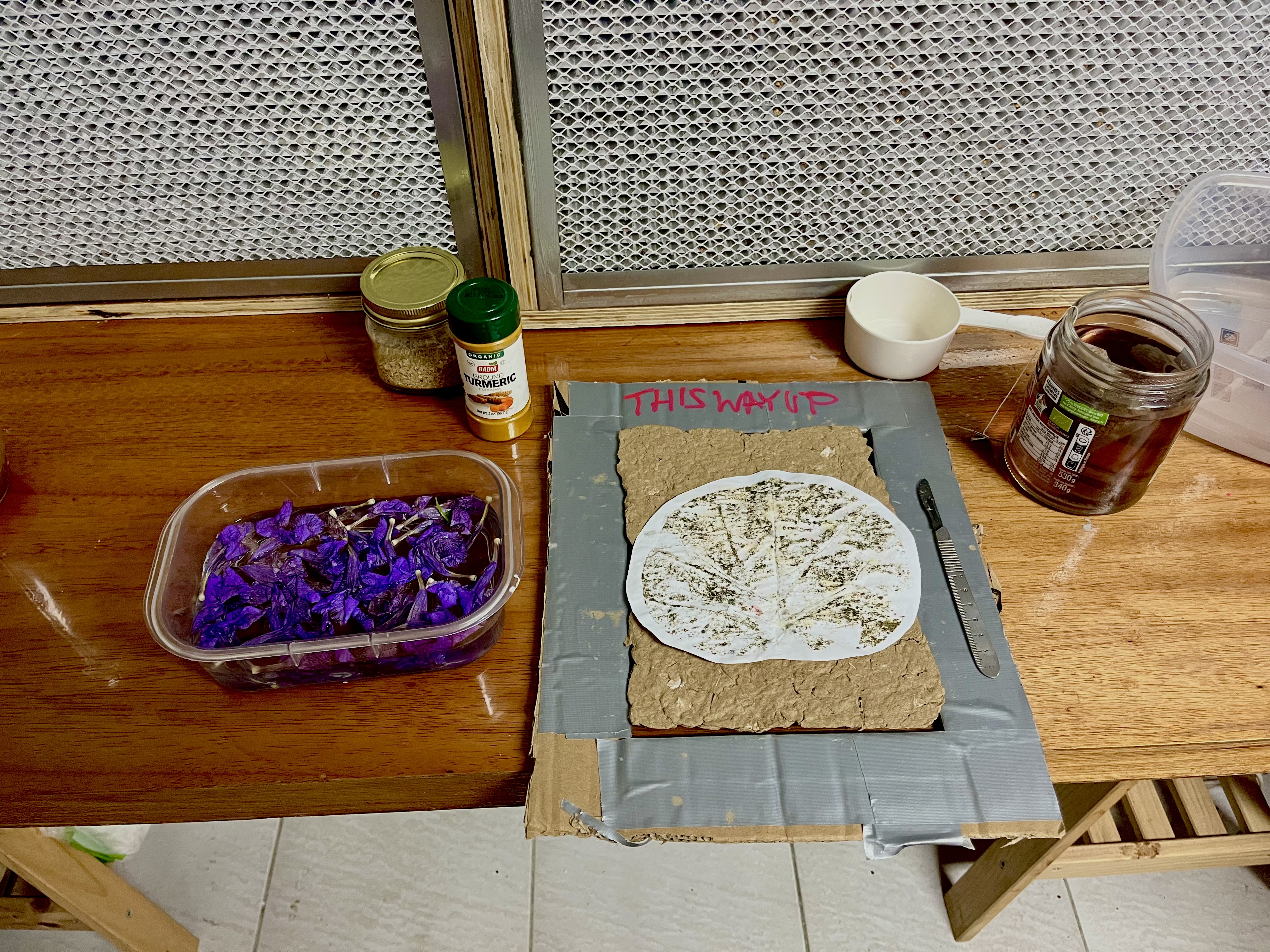
"This Way Up" - My first attempt at pressing a page with a cardboard mold. Mexican Petunia petals and other dye/pulp ingredients ready to be added. All the cardboard boxes I rescued for the pulp were originally from the local Carrefour market (a chain supermarket on the island that stocked our mushrooms) and would have been crushed in their giant cardboard box death grinder and sent to the infamous and already overflowing Sint Maarten landfill.

The pulp for this page consisted of half brown cardboard, half egg carton. For dyes and other additives, turmeric was added for a warmer tone. White vinegar was also added to lower pH. The slight acidity reduces microbial growth and helps bind and preserve fibres, important for when I would come to print spores and frame it.
The two light-brown/cinammon prints are from a couple of slippery jack mushrooms, Suillus luteus, a bolete (bolete mushrooms have pores under the cap where you would usually find gills, the King Bolete, or Porcini, is the most recognisable member of this family). Looking closely you can see there is another bolete on this particular piece. The two darker brown poroid prints are from a couple of sticky boletes, Suillus viscidus. These two species were found growing side by side on a rainy late-October day. The slippery jack is common, I have encountered it many times before, but to my excitement the sticky bolete is quite uncommon, this was my first time finding it (clearly a critter beat me to it, chewing several holes into the surface of the pores. I like how these gaps turned out though, adding a bit of texture and preserving the memory of the insect's dinner that day). These two slimey species reportedly grow together quite often, they are sharing the roots of a nearby larch tree together, their mycorrhizal host. I wanted to reflect their togetherness in life by putting their spores on the same page, giving me a good centrepiece for this one. Hopefully long after their larch tree dies and they seperate, this piece will persist as an archive of how they thrived on that grassy verge besides a busy main road. I finished this piece off by filling out the remaining negative space with black and brown spored agarics. Notice the heavy black prints, these were from mica caps, Coprinellus micaceus. I experimented with leaving the caps over 24 hours, as these mushrooms literally digest into an inky spore filled puddle which left heavy blotches of black pigment on my paper.


Notes about how the photograph was taken and the results.